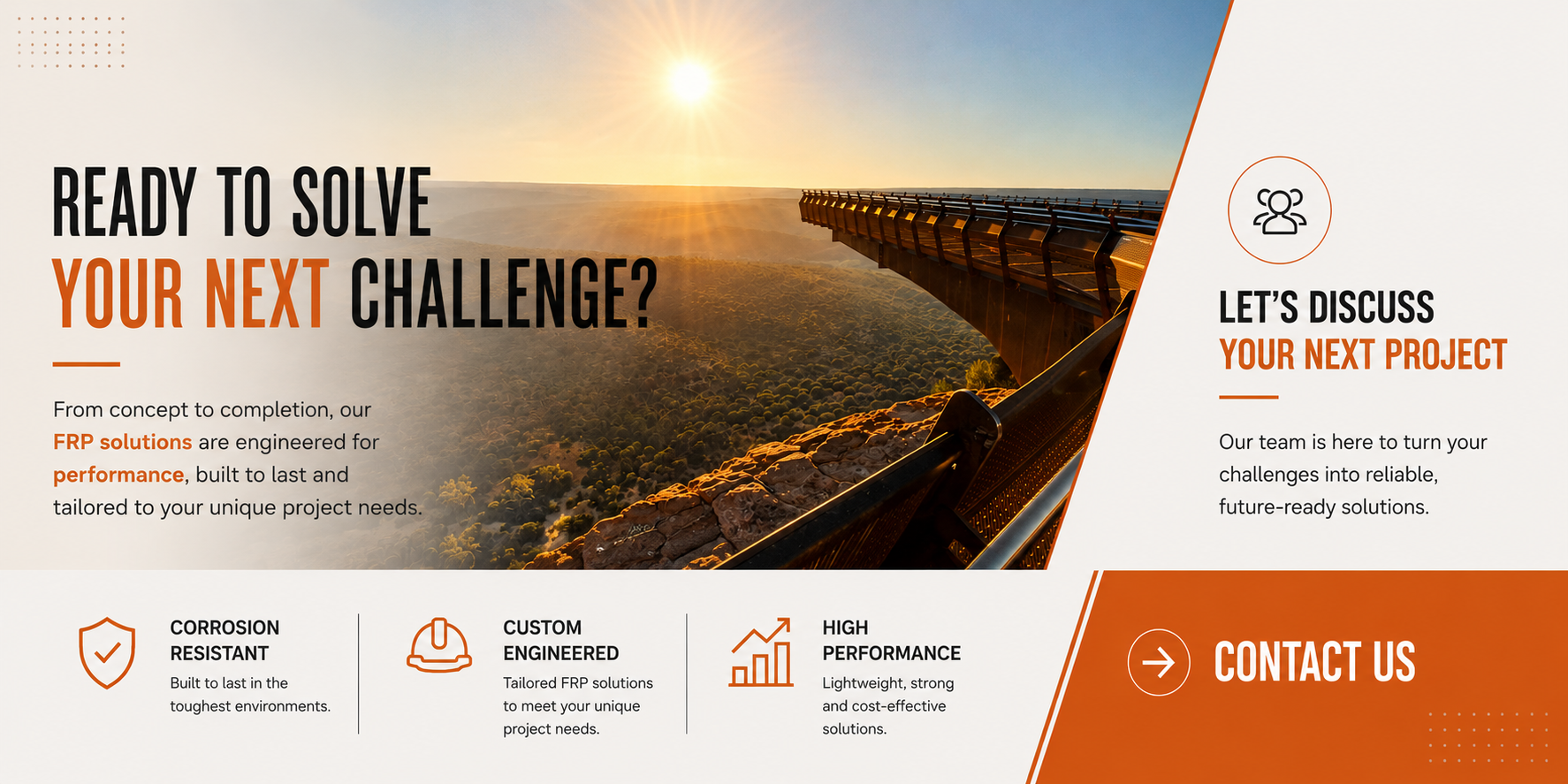
Public walkways are expected to do a lot without attracting much attention.
Whether providing access through a coastal reserve, connecting public facilities, creating a viewing platform or guiding pedestrians through a park, the best walkway systems provide safe, reliable access while standing up to their surrounding environment.
For asset owners, councils, engineers and designers, however, achieving that performance over the long term requires careful material selection.
Increasingly, Fibreglass Reinforced Plastic (FRP) is providing an alternative to traditional materials for public walkways, boardwalks and access infrastructure.
The Challenge of Outdoor Access Infrastructure
Public walkways can be exposed to a combination of moisture, salt, UV exposure, changing weather conditions and constant pedestrian traffic.
These conditions can create ongoing challenges for traditional construction materials.
Steel may require protective coatings and ongoing maintenance to manage corrosion. Timber can deteriorate, rot or require regular treatment, particularly in wet and coastal environments. Other surfaces can also become slippery when exposed to moisture.
The initial construction cost is therefore only one part of the equation.
For infrastructure expected to remain in service for many years, maintenance requirements, replacement cycles, installation requirements and disruption should all form part of the material selection process.

Why FRP Grating Works Well for Walkways
FRP grating combines glass fibre reinforcement with a resin matrix to produce a strong, durable composite material.
For outdoor walkway applications, this provides several practical advantages.
Corrosion Resistance
One of FRP’s most significant advantages is its resistance to corrosion.
Unlike steel, FRP does not rely on galvanising or protective coatings to provide corrosion resistance. This makes it particularly well suited to coastal, marine, wastewater and high-moisture environments where conventional materials can deteriorate more quickly.
For public infrastructure located close to the ocean or exposed to water, this can significantly reduce ongoing maintenance requirements.
Slip-Resistant Access
Pedestrian safety is an important consideration in any walkway design, particularly where surfaces may regularly become wet.
FRP grating can incorporate slip-resistant surface finishes to provide additional grip underfoot, making it suitable for applications including walkways, ramps, platforms, stairways and boardwalks.
Selecting the appropriate grating and surface finish for the specific environment is an important part of the design process.


Lightweight Construction
FRP offers a high strength-to-weight ratio and is considerably lighter than many traditional construction materials.
This can provide benefits throughout a project — from transportation and handling through to fabrication and installation.
Lighter components can also be particularly valuable where access to the project site is restricted or where reducing loads on the supporting structure is important.
For remote, coastal or environmentally sensitive locations, easier handling and installation can become a significant project advantage.
Lower Maintenance Over the Asset Lifecycle
Public infrastructure needs to be considered beyond its initial installation.
Repeated painting, coating, treatment, repair and eventual replacement all contribute to an asset’s whole-of-life cost.
FRP’s corrosion resistance and low maintenance requirements can reduce the level of ongoing intervention required over the service life of an access system.
That makes lifecycle performance an important consideration when comparing FRP with materials that may carry a lower upfront cost but require greater maintenance over time.
More Than Just Grating
An effective public walkway is rarely just a section of flooring.
Depending on the project, the complete access system may incorporate:
- FRP grating
- Structural profiles
- Handrails
- Stair treads
- Platforms
- Ramps
- Pedestal supports
- Custom fabricated components
Considering these elements as an integrated system lets you design the walkway around the site rather than treating individual products in isolation. At FRP Engineering, our approach covers the project from design through to fabrication and installation, helping ensure each component works together as part of a complete access solution.
Designing for the Environment
No two walkway projects are exactly the same.
A coastal boardwalk faces different conditions to an elevated access platform, public viewing area or pathway through a wetland.
Grating type, load requirements, span, surface finish, supporting structure, environmental exposure and access requirements should therefore be considered during the design process.
This is where working with an experienced FRP team can make a difference.
Rather than simply selecting a product, the objective is to design an access system that is appropriate for its environment, meets the project’s requirements and continues to perform over the long term.
Building Public Infrastructure for the Long Term
Good public infrastructure should be safe, durable and straightforward to maintain.
FRP provides designers and asset owners with an increasingly practical option for achieving those objectives, particularly in coastal, wet and corrosive environments.
With corrosion resistance, slip-resistant options, lightweight construction and low maintenance requirements, FRP walkway systems can deliver reliable pedestrian access while helping reduce maintenance demands throughout the life of the asset.
At FRP Engineering, we design, fabricate, and install complete FRP access solutions for projects across a wide range of environments.
Planning a new walkway, boardwalk or public access project?
Talk to our team about an FRP solution designed around your site, application and long-term performance requirements.